Underwater C³-JEPA: An Object-Centric Cross-View World Model for ROV Salvage
About
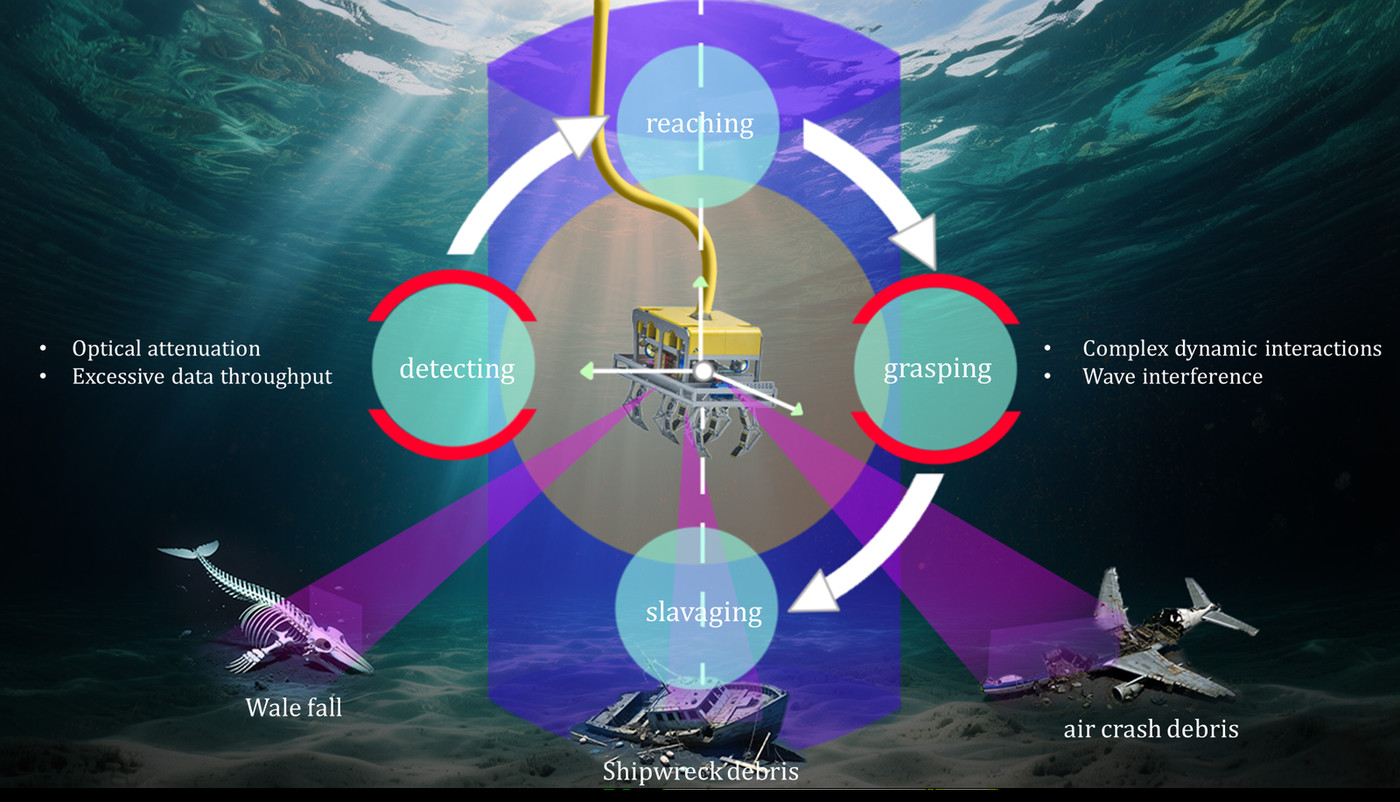
I am a master's student at Shanghai Jiao Tong University, advised by Dr. Xuyang Wang. My work is on world models for robot manipulation in the underwater setting — building predictors that reason about how a salvage ROV and its grippers interact with an object when vision is poor, contact is unobserved, and the vehicle's dynamics lag behind its commands.
Before that I studied Naval Architecture and Ocean Engineering at Dalian University of Technology, where I worked on bionic amphibious vehicles and linkage-driven grippers.
Research interests
- World models for embodied AI — object-centric representation, latent prediction under control conditioning, diffusion and flow-matching planners
- Underwater robot dynamics — ROV–manipulator multibody modelling and grey-box residual correction of hydrodynamic models
- Underactuated grasping — closed-form kinetostatics and dynamics of linkage grippers, and learning on top of them
Publications
Rapid Salvage of Deep-Sea Underactuated Manipulators: Real-Time Solution of Contact Forces and Impact Assessment of Disturbance Forces
Multibody Dynamics and Residual Correction for Underactuated Linkage Grippers
Research experience
World-model-based planning for deep-water salvage ROV (C³-JEPA)
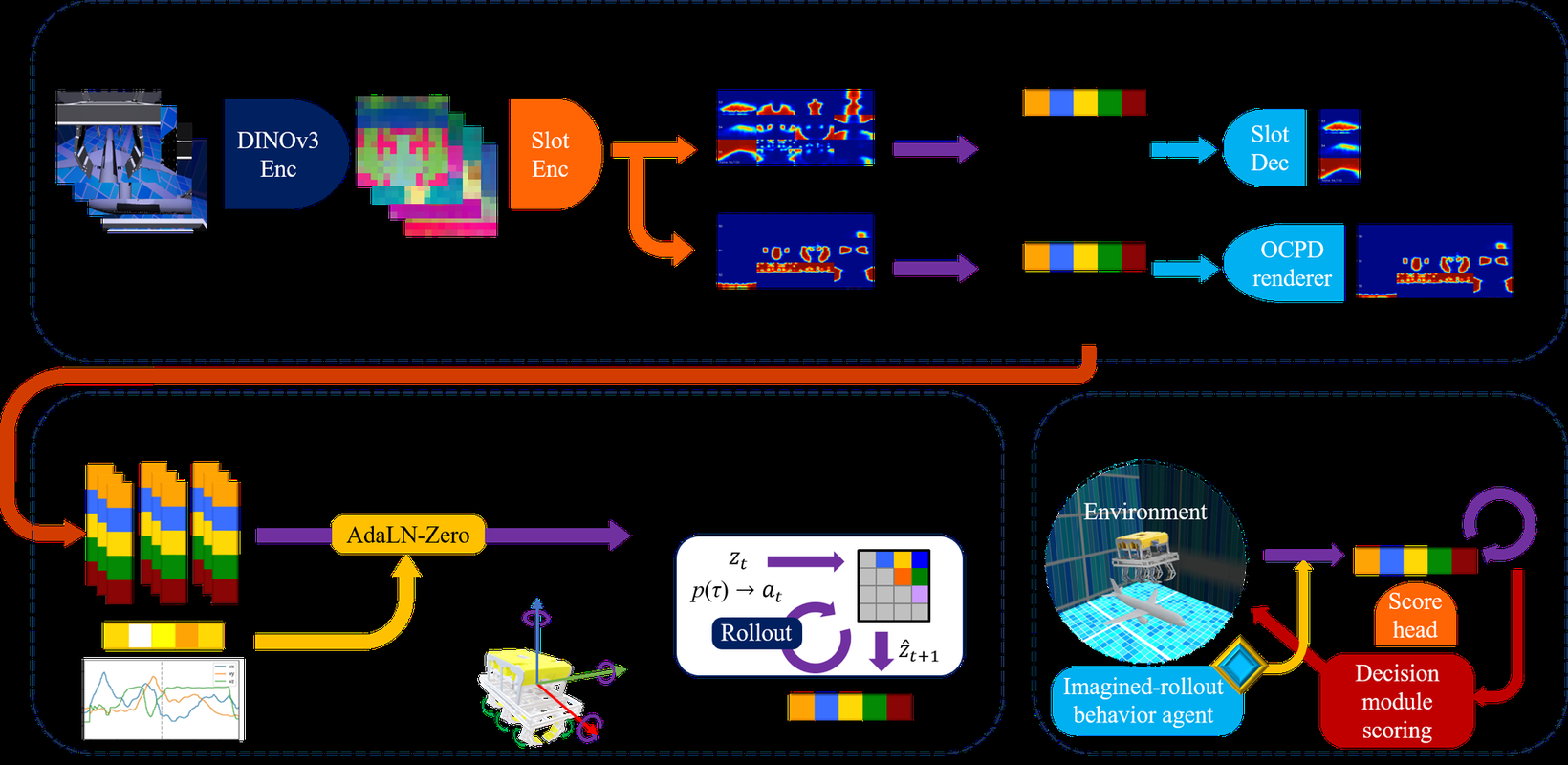
- Benchmarked competing world-model designs — Dreamer-style latent imagination, DIAMOND diffusion models and pure JEPA — before converging on C³-JEPA, a cross-view, control-conditioned and context-extended design.
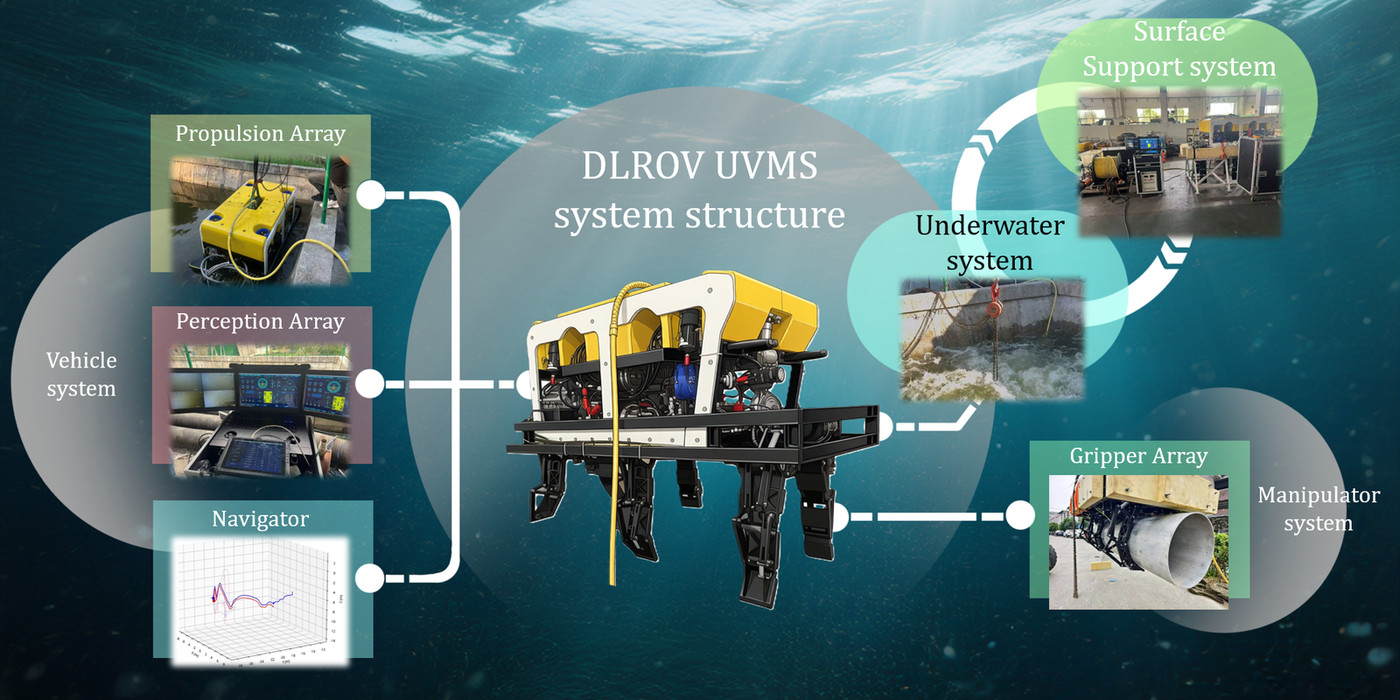
- Built a ROS–Gazebo data foundation (experimental pool, domain randomisation, teleoperation GUI) and collected a large synchronised multi-modal dataset across multi-camera vision, proprioception and all 12 thruster / 6 gripper control channels.
- Designed the observation module (frozen DINOv3-L features, temporal slot attention, SIGReg) and a lightweight object-centric predictor that fuses several camera views under control conditioning.
- Built a flow-matching diffusion planner with spherical-coordinate encoding and delay-compensated label shifting, plus a block-causal transformer rollout with critic-based trajectory selection.
- Learned slots isolate the task object and the grippers where unguided self-supervision fails outright; C³-JEPA with the flow-matching planner cuts terminal positioning error by roughly a third and ranks candidate trajectories well above chance.
Grey-box inverse dynamics for the salvage ROV
- Formulated a physics-informed inverse-dynamics module coupling Fossen's 6-DOF equations with learned hydrodynamic parameters and a gated residual network, recovering thruster commands from observed vehicle motion.
Underactuated salvage gripper: kinetostatics, multibody dynamics and residual correction
- Built a virtual-work-based kinetostatic model of a double four-bar underactuated gripper giving fast closed-form contact-force and load-capacity solutions, and used it to assess environmental disturbance forces on the grasp.
- Validated the solver against ADAMS simulation and an experimental gripper prototype; derived the closed-form multibody dynamics via screw theory, resolving closed kinematic loops with non-minimal coordinates and Lagrange multipliers.
- Coupled the physical model with a parameter network and gated residual correction to absorb contact, friction and unmodelled hydrodynamic effects.
Project video
Patents
- 1st inventor. Control System and Control Method for a Bionic Sea-Turtle Amphibious Vehicle. CN202310492163.5Filed
- 4th inventor. Deep-Water Target Salvage Apparatus and Salvage Method. CN119329722BGranted
- 4th inventor. Adaptive Underwater Adsorption Device and Underwater Salvage Apparatus. CN119262239BGranted
- 4th inventor. Heavy Fuel Oil Heating System and Heating Method for Deep-Water Shipwrecks. CN121357744AUnder examination
- 5th inventor. Bionic Sea-Turtle Flapping-Wing Locomotion Device. CN202310401637.0Filed
Education
Shanghai Jiao Tong University
Dalian University of Technology
Contact
Underwater Engineering Institute, Shanghai Jiao Tong University
800 Dongchuan Road, Minhang District, Shanghai 200240, China